
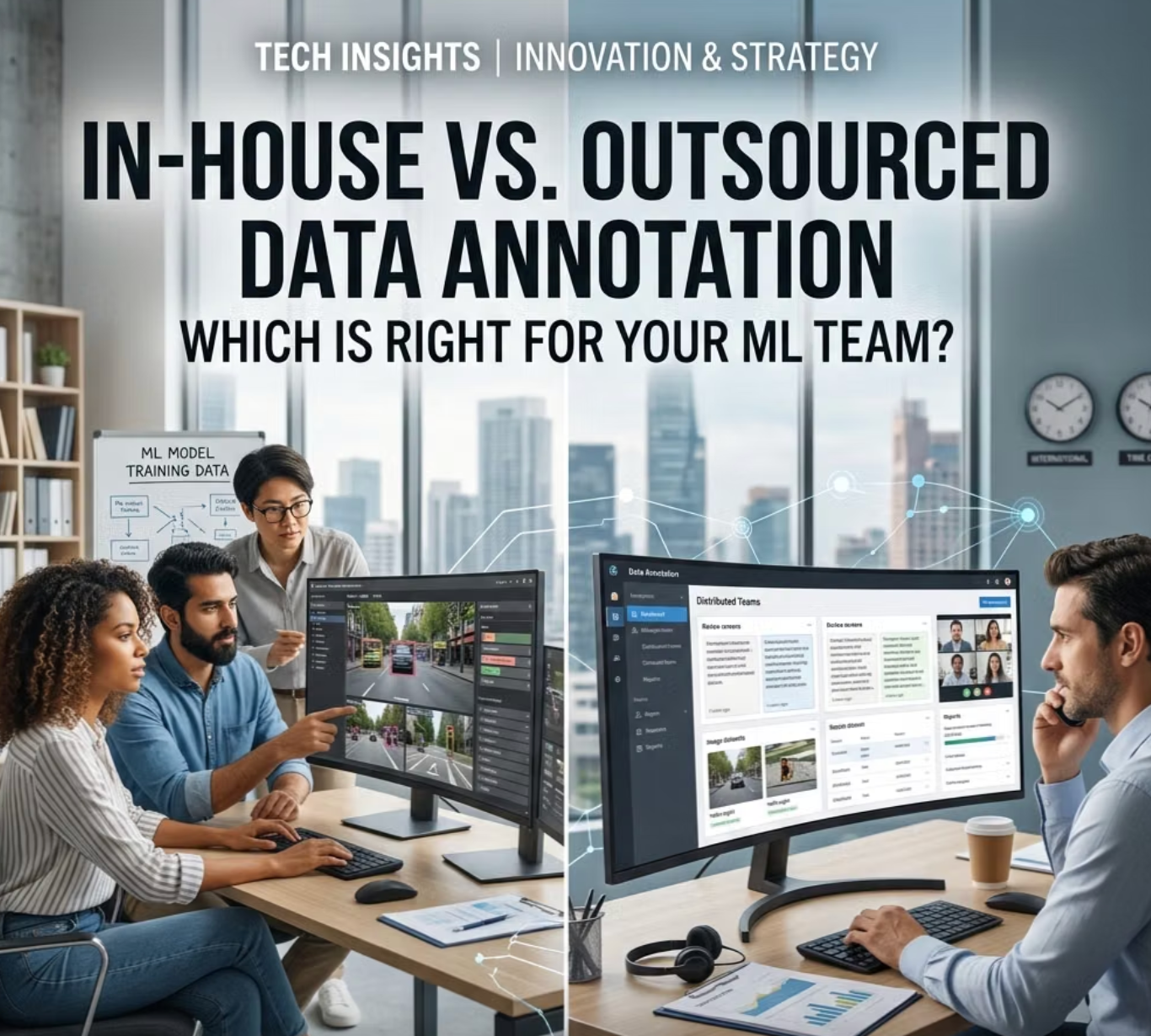
Wondering whether to build an internal annotation team or hire an external provider? Here’s exactly how to decide based on your data sensitivity, budget, and timeline.
Every ML engineer eventually hits the same wall: you’ve built a promising model, but the training data needs labels—and lots of them. Suddenly, you’re staring at a choice that can make or break your project timeline. Do you hire and train your own annotation team, or do you outsource the work to specialists? It’s not just about cost. The decision impacts data security, quality control, and how quickly you can iterate. We’ve seen teams that thought they’d save money with in-house end up bleeding time on QA. Others who outsourced to the cheapest bidder got back unusable labels . Let’s break down what actually matters. According to recent data, the global market for data annotation is projected to reach $19.92 billion by 2033, yet the industry faces a talent gap of nearly 30 million workers . This means finding and keeping skilled annotators is only getting harder, regardless of whether you go internal or external.
The Cost Reality: It’s Not Just About the Hourly Rate
When comparing costs, most teams look at the obvious numbers: salaries vs. vendor fees. But the real picture is much bigger than that. In-house teams come with hidden costs that eat through budgets before you even notice. Think about recruitment, training time, management overhead, tooling, and the expensive reality of staff turnover .
Here’s the breakdown most people miss:
| Cost Factor | In-House Team | Outsourced Provider |
| Cost Structure | Fixed, CAPEX-heavy; paid regardless of work volume | Mostly variable, OPEX; tied to actual output |
| Initial Setup | $50,000–$150,000+ for recruitment, training, tools | $0–$5,000 onboarding fees |
| Annual Labor (10 annotators) | $300,000–$600,000 (US-based) | $80,000–$250,000 (regional variation) |
| Infrastructure & Tools | $10,000–$50,000/year to buy/build and maintain | Often included in service fees |
| Management Overhead | 15–25% of labor cost for supervision | 5–10% (project coordination only) |
| Scaling Flexibility | Low (4–8 weeks to hire) | High (can scale in days) |
| Rework & Turnover | High risk; each departure resets ramp time | Absorbed by the partner’s system |
The key number to track is the fully loaded cost per accepted label. Divide your total spending—labor, tooling, QA, rework—by the number of labels that actually pass quality checks and make it into your model. For most projects with variable needs, outsourcing wins on cost alone . Outsourcing can cut costs by 40-60% compared to building an in-house team . That frees up capital to invest in model innovation rather than data operations.
The Quality and Control Trade-off: Who’s More Accurate?
Quality is where the in-house vs. outsourced decision gets nuanced.
In-house gives you direct control and close oversight. For projects involving ultra-sensitive data (think healthcare or finance), the security of keeping everything inside your perimeter might outweigh other considerations . When you need domain experts who understand your specific industry context, internal teams can align perfectly with your internal pipelines. However, building this expertise takes time, and your team’s bias can creep in—internal employees often share overlapping beliefs and workflows, which can skew data diversity .
Outsourced providers, especially specialized ones, bring a different quality advantage: professionalism. They operate with repeatable production workflows, built-in QA layers, and advanced tooling . They handle huge volumes of data consistently and can spot errors that an internal team, stretched thin, might miss. The key is choosing the right provider and treating them like an extension of your ML team—with clear SLAs, QA metrics, and regular check-ins .
A practical example: A team working on point cloud annotation for autonomous vehicles found that tool selection directly impacted output quality and project timelines . Whether your team is internal or external, the tools and processes they use matter just as much as the people.
Speed and Scaling: Getting to Market Faster
How fast can you start? How fast can you scale?
- In-house is slow to start. You’re looking at 4–12 weeks just to hire and train a team . Scaling up means more hiring cycles. But once running, a stable in-house team can build deep knowledge and become highly efficient for long-term, steady-state projects.
- Outsourcing means speed. You can tap into pre-trained teams and established workflows in 1–2 weeks . Need to annotate 100,000 images this week? A good provider can ramp up instantly. Need to slow down next month? No problem. This flexibility is a game-changer for startups and dynamic projects.
If getting your AI to market first is the priority, outsourcing gives you the velocity you need to beat the competition.
Data Security: The Elephant in the Room
Let’s talk about what keeps compliance officers up at night. If you’re handling medical records, financial transactions, or personally identifiable information (PII), security isn’t just a checkbox—it’s the whole game.
In-house naturally scores higher here because data never leaves your infrastructure. You control access, monitor usage, and enforce security protocols directly. For organizations subject to HIPAA, GDPR, or CCPA, this level of control can be non-negotiable. However, don’t assume in-house means inherently secure—you still need proper encryption, access logs, and employee training to prevent internal leaks.
Outsourced providers have made massive strides in security. Reputable vendors now offer:
- SOC 2 Type II and ISO 27001 certifications
- On-premises deployment options where data never leaves your servers
- Blind annotation setups where annotators only see unlabeled data without context
- Dedicated teams with strict NDA and non-compete agreements
The decision comes down to your risk tolerance and regulatory requirements. Some healthcare companies choose in-house for patient data but outsource de-identified medical images for non-critical tasks. For most commercial applications, a certified vendor with robust data protection measures is perfectly adequate.
The Hidden Costs of In-House: Turnover and Training
Here’s a scenario that plays out constantly. You hire five annotators, spend three weeks training them on your specific taxonomy and tooling, and they finally reach acceptable quality levels after two months of production. Then one leaves. Then another. Suddenly you’re back to square one, burning budget on recruitment while your model starves for new data.
The data annotation industry has notoriously high turnover. According to a 2024 industry report, average annual turnover among in-house annotation teams ranges between 30% and 45%. Each departure costs you not just the recruitment expense but also the lost productivity during the training gap. This is where outsourcing shines—the provider absorbs turnover internally, maintaining a consistent pool of vetted, trained annotators who are ready to work on your project immediately.
A Real-World Scenario: Let’s Follow Two Teams
Company A: HealthTech Startup
Building a diagnostic AI for chest X-rays. Data is highly sensitive (HIPAA-protected), and they need radiologists to validate annotations. They choose an in-house team of four medical annotators supervised by their lead data scientist. Total cost: ~$350,000/year. Benefit: complete control, instant feedback loops, and deep integration with their internal pipeline. Drawback: they’re slow to scale and recently lost a senior annotator, causing a two-month delay.
Company B: E-Commerce Platform
Building a product categorization model for 2 million SKUs. Data is public product images and descriptions—no sensitive information. They choose to outsource to a specialized vendor. Total cost: ~$120,000 for the entire project delivered in six weeks. Benefit: fast, cost-effective, and they can focus on model development. Drawback: occasional misclassifications require additional QA cycles, and they have less visibility into the annotation process.
The Lesson: Your data type, timeline, and budget will point you in different directions. Neither company made the wrong choice—they just optimized for different priorities.
An Original Framework: The Annotation Decision Matrix
To make this easier, here’s a simple framework you can use right now to evaluate your specific situation. Score each factor from 1 (low) to 5 (high) and see which option wins:
| Factor | Score (1–5) | Weight | In-House Fit | Outsourced Fit |
| Data sensitivity | __ | 3 | High score → In-house | Low score → Outsource |
| Need for domain expertise | __ | 3 | High score → In-house | Low score → Outsource |
| Budget flexibility | __ | 2 | Low score → Outsource | High score → Outsource |
| Urgency to launch | __ | 2 | Low score → Outsource | High score → Outsource |
| Long-term volume stability | __ | 2 | High score → In-house | Low score → Outsource |
| Access to specialized tools | __ | 1 | Low score → Outsource | High score → Outsource |
How to use it: Total your weighted score for each column. If In-House wins, start planning your internal team. If Outsourced wins, start vetting vendors. If it’s close, explore a hybrid approach.
So, Which One Is Right for Your Team?
Most ML teams eventually land on a hybrid approach—and for good reason . They keep a small core in-house for sensitive or complex work while outsourcing high-volume, repetitive tasks. This way, you balance control and cost savings.
Choose In-House If:
- Your data is highly sensitive (HIPAA, GDPR)
- You need deep, ongoing domain expertise that’s unique to your business
- You have a long-term, stable annotation need with consistent volume
Choose Outsourcing If:
- You need to start quickly and scale flexibly
- You’re a startup with limited budget for infrastructure
- You want to offload management overhead and focus on core ML work
The Hybrid Model If:
- You have mixed data sensitivity levels
- You want the best of both worlds: control and cost savings
Your time and your data scientists’ time are your most expensive resources. Don’t waste them wrestling with labeling software or managing annotator turnover. Treat annotation as the critical operation it is, and your models will thank you for it.
Practical Steps to Get Started
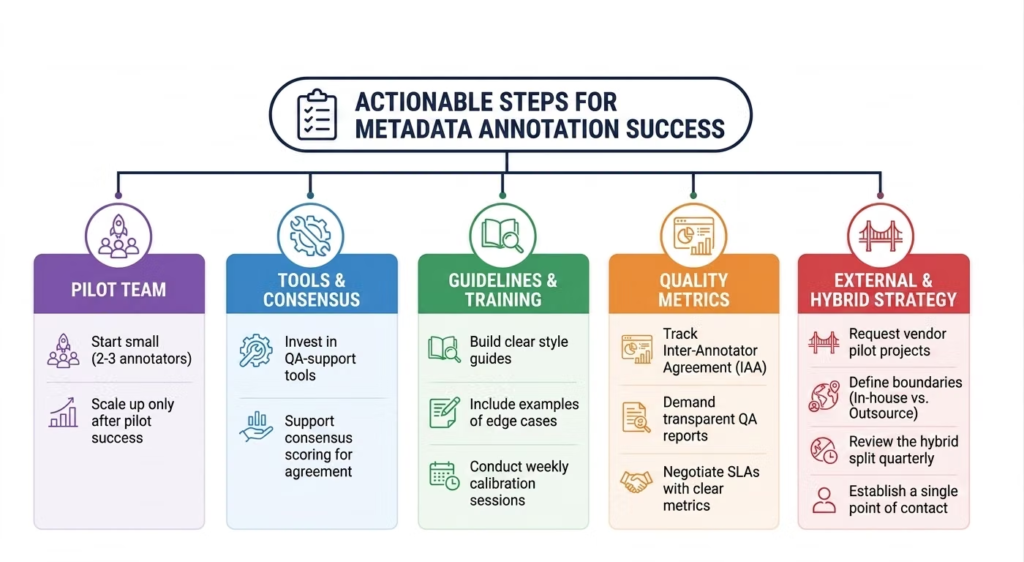
Whatever path you choose, here are actionable steps to set yourself up for success:
For In-House:
- Start with a pilot team of 2–3 annotators before scaling
- Invest in annotation tools that support QA workflows and consensus scoring
- Build clear style guides with examples of edge cases
- Implement weekly calibration sessions to maintain consistency
- Track inter-annotator agreement (IAA) as your primary quality metric
For Outsourcing:
- Request a pilot project with 1,000–2,000 examples before full commitment
- Demand transparent QA reports and access to raw annotation data
- Negotiate SLAs with clear metrics: accuracy, throughput, and turnaround time
- Build a feedback loop to continuously improve guidelines
- Consider geographic and time-zone alignment for smoother collaboration
For Hybrid:
- Define clear boundaries: what stays internal vs. what goes external
- Use the same tooling for both teams to maintain consistency
- Establish a single point of contact for vendor management
- Regularly compare quality metrics between internal and external teams
- Review the split quarterly and adjust based on project needs
Conclusion
Your time and your data scientists’ time are your most expensive resources. Don’t waste them wrestling with labeling software or managing annotator turnover. Treat annotation as the critical operation it is, and your models will thank you for it.
The market is flooded with AI solutions, but behind every successful model lies a mountain of carefully labeled data. Whether you build that mountain with in-house expertise or outsource it to seasoned professionals, the key is making an informed decision based on your unique constraints—not following trends or cutting corners. Start small, measure everything, and iterate. Your model’s performance depends on it.