

You’ll learn: Why traditional manual annotation is becoming obsolete, how to implement a tiered human-in-the-loop workflow, and exactly how much time and money you can save with AI-powered pre-labeling.
The global data labeling market is on a trajectory of explosive growth. Recent industry analyses estimate the market was valued at approximately $18.1 billion in 2025 and is projected to reach a staggering $71.5 billion by 2032, growing at a compound annual rate of 21.7% . For ML practitioners, data scientists, and business leaders, this represents a persistent pressure point: annotation costs can devour your budget, especially as datasets scale into the millions of samples.
Fortunately, a significant workflow shift is already delivering dramatic results. A study on medical image annotation, for instance, found that using AI for pre-annotation could save at least 30% of the manual annotation workload when working with limited datasets . When dataset sizes grew larger, the AI model’s classification accuracy became comparable to that of junior physicians, effectively eliminating the need for manual preliminary annotation altogether .
The secret isn’t replacing human annotators—it’s flipping the script. Instead of starting from a blank canvas, annotators review and correct AI-generated drafts.
How Pre-Labeling Actually Works (and Why It Saves So Much Time)
The core concept is deceptively simple: train a model on a small batch of manually labeled data, then let it generate labels on new, unlabeled data. These AI-generated “pre-labels” serve as starting points for human annotators . Rather than drawing bounding boxes from scratch, annotators simply verify, adjust, or reject existing ones.
A study on active learning enhancements found that strategically selecting the most informative samples for labeling could reduce overall annotation costs by up to 33% in terms of classification accuracy improvement . Moreover, research on human-LLM collaboration for data labeling demonstrated that targeted human review can reduce manual labeling effort by up to 80% while outperforming fully automated approaches .
Here’s what this shift does to your workflow:
- From Creation to Verification: The annotator’s role changes from creating labels to reviewing them, which is inherently 3-5x faster.
- Reduced Cognitive Load: Annotators check if the AI got it right rather than deciding whereobjects are from scratch.
- Focused Human Effort: Your most skilled annotators can focus on edge cases, complex scenes, and ambiguous examples where human judgment is truly irreplaceable .
The Results Speak for Themselves
| Workflow Type | Time Saving vs. Manual | Human Effort Level | Best Use Case |
| Manual (from scratch) | Baseline (0%) | Full creation | Small datasets, complex edge cases |
| AI Pre-Labeling (Verification) | 30-68% reduction | Review, correct, reject | Large-scale projects, repetitive tasks |
| Hybrid (Active Learning) | Up to 80% reduction | Targeted expert input | Projects with limited labeled data |
Sources: Thyroid ultrasound study: 30% initial workload reduction, approaching 100% automation after iterative rounds (Fu et al., PLOS Digital Health, 2025); Kognic auto-label platform: up to 68% reduction in annotation time across real customer projects; HILTS framework (Human-LLM collaboration): reduces human labeling effort by up to 80% while outperforming few-shot foundation models
The Real Impact: What the Data Shows
To truly appreciate the impact of pre-labeling, let’s look at concrete research findings.
Figure 1: Annotation Time Savings Across Different Approaches
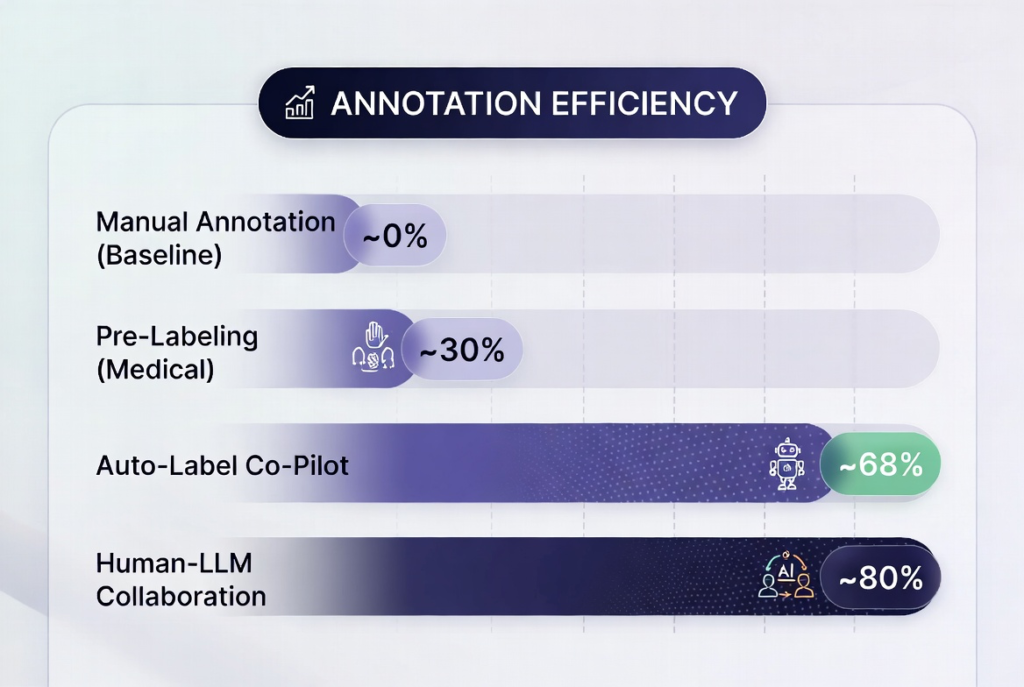
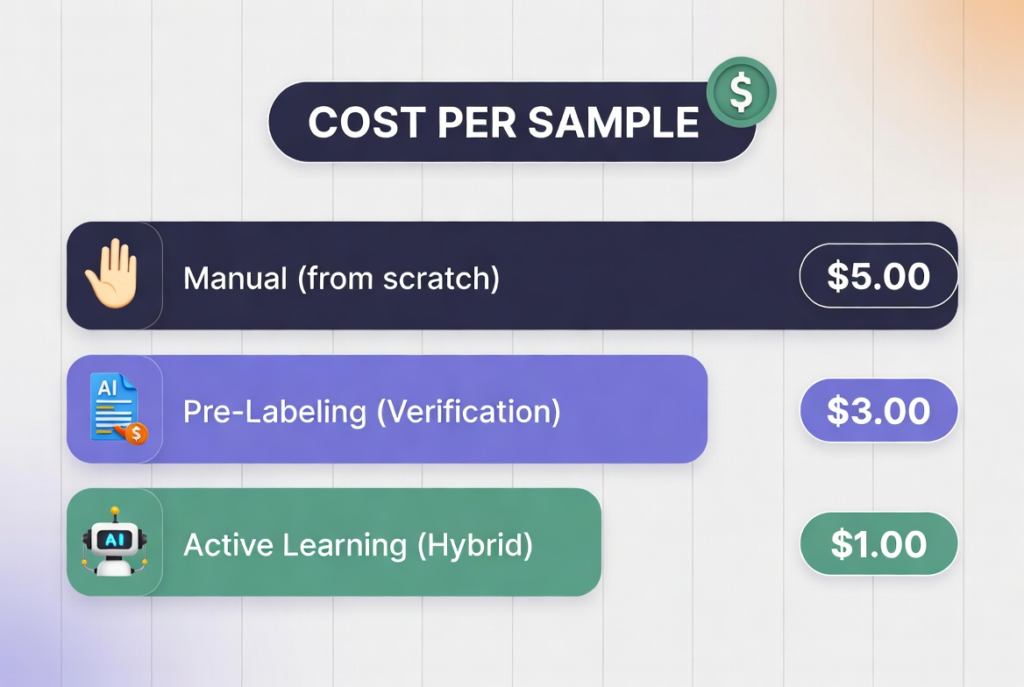
Figure 2: Cost Per Annotated Sample by Workflow Type
Kognic, a company specializing in annotation platforms for sensor-fusion applications, reports achieving up to a 68% reduction in annotation time compared to manual methods without compromising quality . This is achieved by using auto-labels as intelligent prompts that guide automation features like interpolation and one-click fixes, rather than treating them as finished annotations.
The research on HILTS (Human-In-the-loop Learn To Sample) further demonstrates that strategically incorporating human expertise into an LLM-powered automated labeling loop can reduce human effort by up to 80%, particularly effective in handling class imbalance in real-world datasets .
The “Human-in-the-Loop” Workflow: A Practical Blueprint
The magic isn’t just in the AI—it’s in the system design. A hybrid or “human-in-the-loop” (HITL) workflow optimizes for both speed and accuracy.
1. The Routing Logic is Key
Don’t treat all pre-labels the same. A smart system uses confidence thresholds. High-confidence predictions go to basic verification. Low-confidence ones go to experts. Research has shown that a confidence-based human-in-the-loop workflow can improve annotation reliability while reducing human effort by up to 45% .
2. Build a Tiered Workforce
A tiered workforce is the financial engine of this model:
- Tier 1: Verifiers. Lower-cost workers review high-confidence pre-labels. Quick verification of hundreds of images per hour.
- Tier 2: Domain Specialists. Experts handle ambiguous or complex examples where nuanced judgment is required.
- Tier 3: Senior QA. They audit samples, resolve disputes, and create a feedback loop to improve the underlying pre-labeling model.
3. Beware of “Anchoring Bias”
A significant risk with pre-labeling is cognitive anchoring: annotators shown a candidate label may accept it even when slightly wrong . Errors can become systematic—clustered, not random—making them harder to catch with standard quality checks.
The Fix: Robust QA architecture with randomized audits, reserving safety-critical edge cases for manual annotation from scratch, and training teams to focus on “correcting,” not just “accepting.”
Two Paths to AI-Powered Pre-Labeling
Option 1: The DIY Model (Active Learning)
Train a model on your labeled data and implement an active learning loop:
- Select: Use the model’s uncertainty to identify the most valuable samples for human annotation.
- Annotate: A human expert corrects the model’s attempt.
- Retrain: Feed the corrected labels back into the model and repeat.
Research shows that this approach can improve existing active learning methods by up to 33% in classification accuracy when initial labeled data is extremely limited .
Option 2: The Enterprise Platform
Leverage purpose-built annotation platforms with pre-integrated automation features like interpolation and one-click fixes. Kognic’s platform, for instance, is used by over 70 autonomy programs to achieve up to a 68% reduction in annotation time .
Choosing the Right Strategy
| Factor | DIY Active Learning | Enterprise Platform |
| Upfront Engineering Effort | High | Low |
| Per-Unit Cost | Low (infrastructure only) | Higher (per-annotation fees) |
| Customization | Complete | Limited to platform features |
| Time to Value | 2-6 months | Days to weeks |
| Best For | ML-first teams, unique data types | Teams needing speed, standard data types |
Common Pitfalls and How to Avoid Them
| Pitfall | Why It Happens | The Fix |
| Trusting the Model Too Early | Excitement about automation | Only deploy when model achieves ≥70-80% accuracy on validation set |
| Not Measuring the Right Metrics | Focus on accuracy, not throughput | Track time per annotation before and after |
| Ignoring Class Imbalance | Model weak on rare classes | Route all samples with rare classes to experts |
| Forgetting the Feedback Loop | Set it and forget it | Weekly or bi-weekly retraining cycles |
Conclusion
AI-assisted pre-labeling is rapidly becoming the new standard for data annotation. Whether you’re a student working on your first ML project, a data scientist scaling up a production system, or a business leader trying to control costs, pre-labeling offers a path forward.
The strategy isn’t to automate the human out of the loop but to automate the repetitive parts, empowering your best talent to focus on what truly matters: handling edge cases, ensuring quality, and building a feedback loop that continuously makes your models smarter.
By implementing smart routing logic, building a tiered workforce, and being mindful of cognitive biases like anchoring, you can transform your data labeling pipeline from a costly bottleneck into a strategic asset.