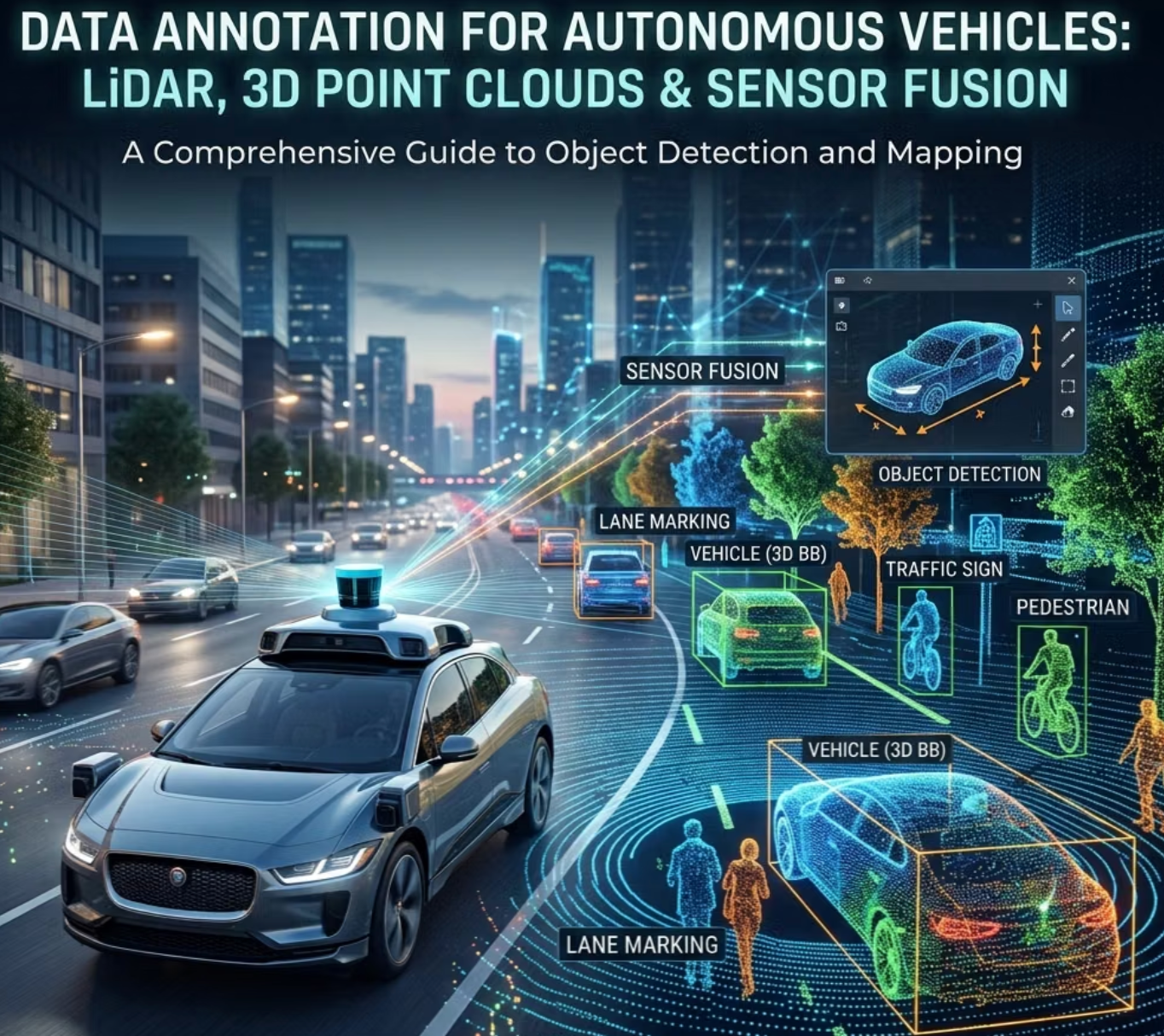
Imagine a self-driving car navigating a busy intersection at dusk in pouring rain. Its LiDAR scanner fires millions of laser pulses to map the 3D world in precise distances, while cameras pick up colors and signs, and radar tracks speeds. None of these sensors work perfectly alone. What turns that raw flood of data into decisions a car can trust? High-quality data annotation and data labeling—specifically for LiDAR point clouds and sensor fusion.
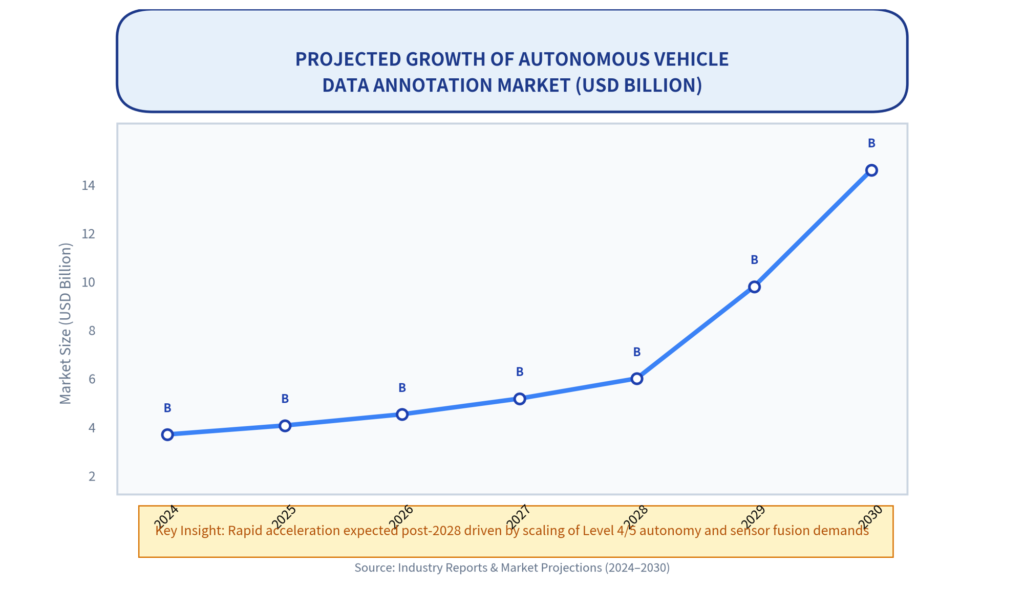
This process labels objects in three-dimensional space so machine learning models learn to detect pedestrians, vehicles, cyclists, and obstacles accurately across changing conditions. Teams building autonomous vehicles rely on it heavily. The global market for autonomous vehicle data annotation hit about USD 1.9 billion in 2024 and is on track for strong growth as companies push toward safer deployment.
Why LiDAR and 3D Point Clouds Matter in Autonomous Driving
LiDAR (Light Detection and Ranging) sensors create dense clouds of points, each with x, y, z coordinates and often intensity values. Think of it as a detailed 3D dot painting of the environment captured dozens of times per second. A single frame can contain hundreds of thousands of points. Without annotation, it’s just noise to a model.
Data labeling here usually involves drawing 3D cuboids (oriented bounding boxes) around objects. Annotators fit these boxes to enclose points belonging to a car, for example, and add attributes like “occluded,” “moving,” or “parked.” This gives models spatial understanding that 2D images alone can’t provide—crucial for judging distances and predicting motion.
Early datasets like KITTI helped kick things off with simpler scenes, but modern ones such as nuScenes and Waymo Open Dataset show the leap forward: full sensor suites, urban complexity, and massive scale with millions of annotated 3D boxes.
Sensor Fusion: Combining Strengths for Robust Perception
No single sensor wins every scenario. Cameras struggle in low light or fog. LiDAR excels at geometry but can miss fine details like text on signs or get sparse at distance. Radar gives velocity but lacks rich shape info. Sensor fusion annotation synchronizes and labels data from all of them together.
In practice, annotators work in tools that project a 3D cuboid from the LiDAR point cloud onto corresponding camera images. This lets them verify consistency across views in one workflow. Misalignment by even a small margin trains bad habits into the model—like failing to spot a cyclist partially hidden by a truck.
Actionable tip: Start fusion projects with precise sensor calibration data. Recalibrate regularly, especially after hardware tweaks. Use temporal tracking across frames to maintain consistent object IDs over time—this reduces flickering detections in video sequences.
Practical Techniques and Best Practices for Annotation Teams
Getting annotation right requires more than clicking boxes. Here are strategies teams use today:
- Pre-labeling with models: Run initial object detection on point clouds to suggest cuboids, then have humans refine them. This cuts time significantly while keeping quality high.
- Handle sparsity and occlusion: Far-away objects have fewer points. Cross-reference with camera views and previous frames. Define clear guidelines for partial labels, like minimum point thresholds per class.
- Quality control loops: Implement multi-stage review—primary annotator, senior checker, and automated consistency checks for overlapping labels or drift across sequences.
- Semantic and instance segmentation: Beyond boxes, label every point (semantic) or individual instances (tracking unique cars even if same class). This powers finer tasks like free-space detection for path planning.
Example in action: In a crowded urban scene, a 3D cuboid around a pedestrian includes attributes for pose (walking, standing) and occlusion level. Fused with camera data, the model learns to predict intent better, even when LiDAR points are sparse due to clothing or angle.
Challenges to watch:
- Massive data volumes demand efficient tools and sampling strategies.
- Weather and lighting variations require diverse training examples.
- Consistency across annotators—use detailed schemas with visual examples for each class.
Here’s a quick comparison table of common annotation types:
| Annotation Type | Best For | Tools/Methods | Pros | Cons |
| 3D Cuboids | Object detection & tracking | LiDAR viewers with projection | Captures volume & orientation | Time-intensive for dense scenes |
| Semantic Segmentation | Scene understanding | Point-wise labeling | Detailed environment map | Computationally heavy |
| Sensor Fusion | Multimodal perception | Synchronized multi-view UI | Robust across conditions | Requires calibration accuracy |
| Instance Tracking | Multi-frame sequences | ID assignment over time | Predicts motion | Handling occlusions & splits |
Visualizing the Process
Infographic: How LiDAR, camera, and radar data fuse into unified perception for autonomous vehicles.
For market context, consider this growth projection based on industry reports:
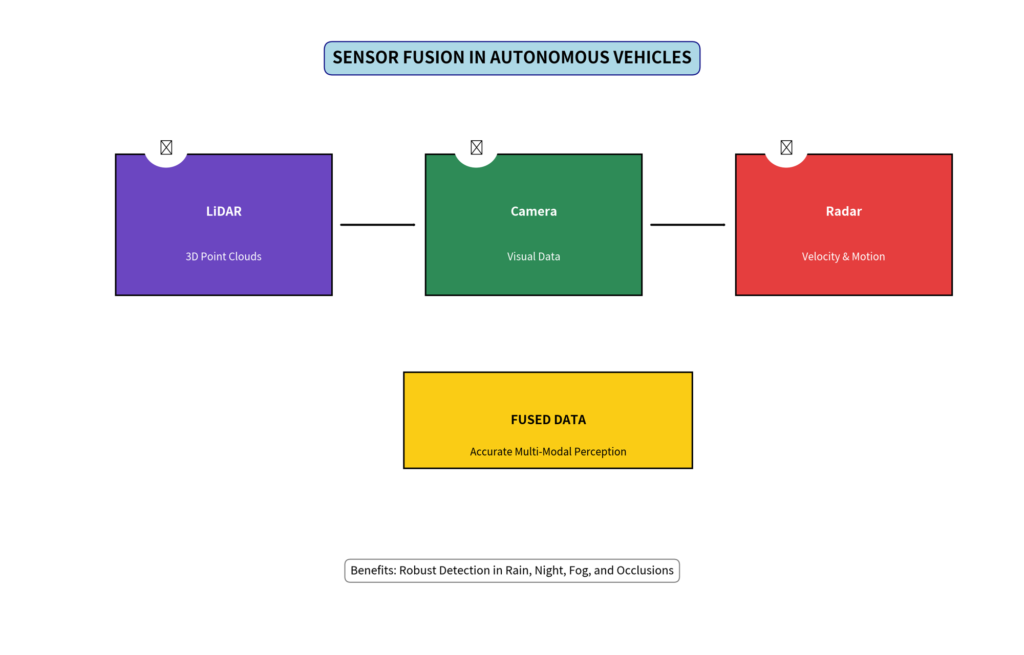
Chart: Projected growth of the autonomous vehicle data annotation market.
These visuals highlight why investment in annotation keeps climbing—better data directly translates to safer systems.
Actionable Steps to Improve Your Annotation Pipeline Today
- Audit your current dataset for fusion alignment errors using projection overlays.
- Pilot active learning: Train a model on a small labeled set, then prioritize uncertain samples for human review.
- Document everything—annotation guidelines, edge cases, and metrics like inter-annotator agreement.
- Test in simulation first: Replay annotated sequences in a virtual environment to catch perception gaps before real-road deployment.
- Scale smartly: Combine in-house experts for complex cases with specialized vendors for volume.
Junior engineers or students starting out can experiment with open datasets like nuScenes. Load a scene, practice fitting cuboids, and train a simple PointNet-style model to see immediate impact.
Key Active Learning Strategies
Here are proven strategies tailored to LiDAR/point cloud and sensor fusion workflows:
- Uncertainty Sampling: The model flags samples where it’s least confident (high entropy, low max probability, or high variance across ensemble models). For 3D detection, this catches ambiguous objects in fog, distant sparse points, or overlapping vehicles. Simple and effective starting point.
- Diversity-Based Selection: Avoids redundant similar samples (e.g., many identical highway scenes). Uses clustering (k-means on features or embeddings) or core-set methods to pick a representative spread across spatial/temporal contexts. Great for covering long-tail scenarios in driving data.
- Query-by-Committee (QBC): Train multiple models (committee) and select samples where they disagree most. Useful for fusion models to highlight sensor conflicts.
- Expected Model Change / Gradient-Based: More advanced—estimate how much the model’s parameters or loss would change if a sample were labeled. Computationally heavier but often more efficient in data reduction.
- Inconsistency-Based: For LiDAR, look at inconsistencies between 2D projections (camera) and 3D predictions, or across frames in a sequence. Helps with temporal consistency in tracking.
- Hybrid / Multi-Modal: In sensor fusion, score based on fused uncertainty or individual sensor disagreements. For example, high disagreement between LiDAR cuboid and camera detection signals a valuable sample.
Temporal and Spatial Considerations in AVs: Driving data is sequential. Strategies that incorporate frame sequences (e.g., selecting informative clips rather than isolated frames) maintain consistency and capture dynamics like object motion. Some frameworks add temporal consistency checks to avoid labeling every frame in a burst.
Practical Implementation Tips for AV Teams
- Start Small: Use 5-10% of data as seed set. Tools like those in research (e.g., Active3D frameworks) can achieve full supervised performance with ~50% labels on datasets like TUMTraf or nuScenes.
- Pre-Labeling Integration: Combine with weak supervision or model-assisted annotation. The active learner suggests boxes/segments; humans fix only the uncertain ones.
- Budget-Aware: Set annotation budgets per cycle. Monitor metrics like mAP improvement per labeled sample.
- Challenges to Address:
- Computational cost of repeated training—use continual/fine-tuning methods instead of from-scratch retraining.
- Bias toward outliers if not balanced with diversity.
- Scalability for massive point clouds—voxel-based or subsampled queries help (see voxel-centric baselines).
- Evaluation: Track not just final accuracy but learning curves (performance vs. labels used) and coverage of edge cases.
Real-World Impact and Examples
In AV pipelines, active learning shines for perception models (e.g., PV-RCNN for 3D detection). Teams report prioritizing uncertain frames surfaces construction zones, wildlife, or ambiguous gestures early. Platforms often integrate it into closed-loop systems: collect data → active query → annotate → retrain → simulate → deploy.
For students or early-career practitioners: Experiment on public datasets like KITTI or nuScenes subsets. Libraries such as modAL (Python) or custom scripts with PyTorch can get you started quickly. Focus on uncertainty + diversity hybrids for best results in 3D data.
Active learning turns the data annotation bottleneck into a strategic advantage. By intelligently choosing what to label, AV developers build more robust, safer systems with less manual effort—directly supporting scalable sensor fusion and real-world deployment. If you’re implementing this, begin with uncertainty sampling on your current model and measure the data efficiency gains.
Сonslusion
Data annotation for LiDAR point clouds and sensor fusion isn’t glamorous, but it’s the quiet work that determines whether an autonomous vehicle reacts correctly when it counts. As fleets expand and regulations tighten, teams that master precise, consistent labeling will pull ahead in safety and performance.
The field continues evolving with better tools, hybrid human-AI workflows, and larger diverse datasets. Whether you’re a data scientist refining models, an engineer integrating sensors, or a business leader scoping AV projects, focusing on annotation quality pays off in fewer surprises on the road. Start small, iterate with real examples, and build datasets that reflect the messy real world—your perception systems will thank you.