Want to break into the AI industry? You’ve probably heard that data annotation (or data labeling) is the easiest way in. And you’re not wrong. In 2026, this role is the foundation of almost every machine learning model you interact with. But a quick scan of the job market reveals a surprising truth: “Data Annotator” can mean anything from a $2,000-a-month tagging role to a $65,000-a-month expert position defining how AI understands the world. According to a recent industry analysis by Grand View Research, the global data collection and labeling market is projected to hit $15.26 billion by 2030, growing at a CAGR of over 27% — which tells you just how critical this function has become for every major tech player.
This guide cuts through the confusion. We’ll show you exactly what annotation and labeling involve in 2026, the real salary landscape, the specific skills that separate the replaceable from the irreplaceable, and the career path from entry-level to AI specialist.
What Is Data Annotation (Data Labeling) in 2026?
At its core, data annotation is the process of labeling raw data—text, images, audio, or video—so that AI models can learn from it. Think of it as a “referee” for AI, telling the model which output is “good” and which is “bad.” Without high-quality labeled data, even the most sophisticated neural network is useless. It’s garbage in, garbage out — and in 2026, companies have finally realized that annotation quality directly determines model performance.
In 2026, the job has evolved from simple “drawing boxes” around objects. It’s about teaching AI to understand context, emotion, and nuance. A voice annotator, for example, doesn’t just transcribe speech; they mark pronunciation deviations, dialect features, and even emotional intent so the model can truly “understand” human language. An image annotator working on medical datasets doesn’t just outline tumors — they differentiate between benign and malignant patterns based on clinical guidelines. This shift from mechanical tagging to semantic understanding is what separates a replaceable worker from a strategic asset.
| Modality | What You Label | Example Project |
| Text | Sentiment, relevance, code quality, dialogue evaluation | Training a chatbot to be less robotic and more empathetic in customer service |
| Image/Video | Bounding boxes, segmentation, keypoint tracking, polygonal masking | Teaching autonomous vehicles to recognize pedestrians in low-light conditions |
| Audio | Speech-to-text, pronunciation, emotion, intent, speaker diarization | Helping voice assistants understand regional accents and background noise |
| Multimodal | A combination of the above (e.g., video with synchronized audio) | Training models to understand context from multiple sensory inputs simultaneously |
| Specialized | Medical imaging, legal document parsing, financial sentiment | Labeling MRI scans for cancer detection or SEC filings for risk assessment |
This is not a dead-end job. The market is bifurcating—splitting into low-skill, low-pay roles and high-skill, high-pay positions. Your job is to choose which side you want to be on.
The 2026 Salary Landscape: The Gap Is Real
One of the most critical things to understand about a career in data labeling is the extreme pay disparity. A recent analysis of job postings across Southeast Asia found a thirtyfold salary gap in a single market — from entry-level taggers earning $2,000–$3,000 per month to senior annotation leads earning over $60,000 monthly in specialized domains.
- The Low-End (Commodity Annotation): This is the “assembly line” of AI. Roles typically involve basic tagging using bounding boxes or simple text classification. They require no degree, minimal training, and often pay hourly or a low monthly salary. For example, a data annotator in Malaysia might earn around RM2,000–3,000 per month. In the US, entry-level contract roles can start at $16–$22 per hour. These positions are increasingly vulnerable to automation — over 60% of simple labeling tasks are now handled by AI-assisted pre-labeling tools, with humans only doing quality assurance.
- The High-End (Strategic Annotation): These are roles that require domain expertise — medical, coding, legal, financial. You’re not just tagging; you’re designing annotation taxonomies, creating guideline documentation, handling edge cases, and working directly with ML engineers to improve model performance. These are the roles that pay upwards of $65,000 per month in some markets (particularly in the US and China for senior roles), with average annual salaries for specialists ranging from $85,000 to $140,000 depending on location and domain.
According to professional salary data from 2026, the average base salary for a generalist annotator in North America is around $45,000–$55,000 USD per year, with a typical bonus of ~$3,000–$5,000. However, senior specialists in fields like autonomous vehicle annotation or medical imaging can earn significantly more, with salary potential increasing by 39% over five years as they move from execution to strategy. A Lead Data Annotation Business Analyst in a tech hub like Sunnyvale or Seattle can command $160,000+ annually, reflecting the strategic importance of the role.
Salary Progression by Skill Tier (2026 Estimates)
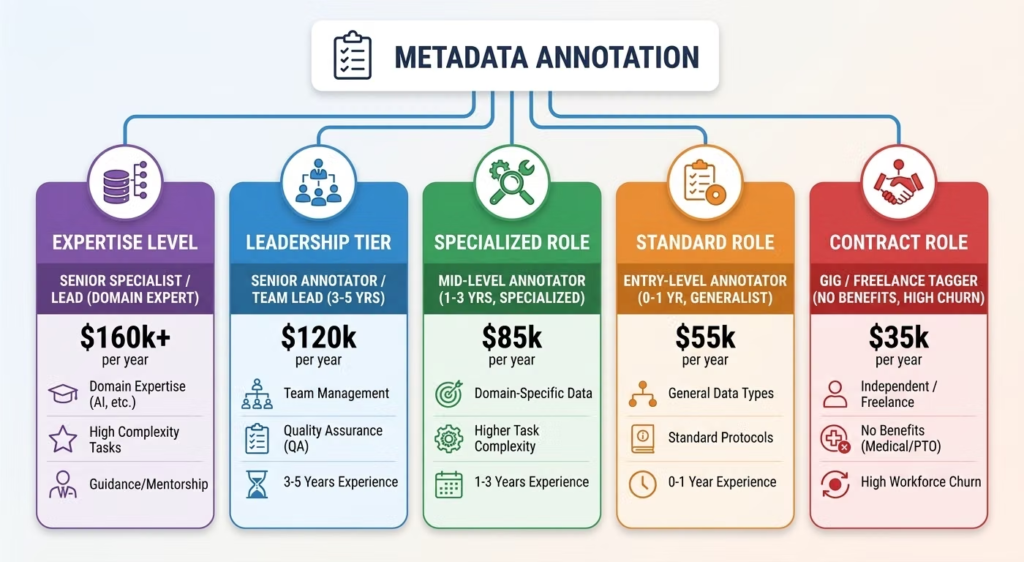
(Source: Compiled from 2026 job postings on LinkedIn, Indeed, and Glassdoor)
How to Become a Data Annotator: A Step-by-Step Roadmap
Ready to get started? The entry point is easier than you think, but to build a career, you need a strategy. Here’s a concrete roadmap with actionable steps.
Phase 1: The Entry-Level Path (Months 1–6)
For beginners, many roles don’t require a degree or technical background. Companies like Scale AI, Appen, Lionbridge, and Sama are constantly hiring remote annotators. They’re looking for detail-oriented individuals with strong reading comprehension and the ability to apply structured guidelines consistently.
- Actionable Step 1: Create profiles on major annotation platforms (Scale AI, Appen, Clickworker, Amazon Mechanical Turk). Apply for 10–15 projects per week across different modalities (text, image, audio) to build a diverse portfolio.
- Actionable Step 2: Treat each project as a learning opportunity. Read the guidelines thoroughly — they’re your most valuable training material. Understand not just what to label, but why the client wants it labeled that way.
- Example: A video annotation role for an autonomous driving project might require you to review 30-second clips and accurately describe human actions, vehicle movements, and environmental conditions in written form. The pay for this contract role is around $24–$28 per hour, but the real value is learning how sensor data is structured.
Pro Tip: Start with generalist projects but track which modalities you enjoy and perform best in. If you’re naturally good at audio transcription, pivot toward speech projects. If you have an eye for detail in images, focus on computer vision tasks. This early specialization will accelerate your career.
Phase 2: The Intermediate Specialist (Months 7–18)
Once you have 6+ months of experience and a portfolio of completed projects, you can start commanding higher rates. At this stage, you should be moving from being a “tagger” to being a “quality analyst” or “senior annotator.”
- Actionable Step 1: Apply for team lead or quality assurance roles within your current platform. These positions involve reviewing others’ work, providing feedback, and refining guidelines — which teaches you the “meta” skills of annotation.
- Actionable Step 2: Invest time in learning the tools of the trade. Familiarize yourself with Labelbox, Supervisely, or VGG Image Annotator. Many of these platforms offer free tutorials and certification programs.
- Actionable Step 3: Take on projects in specialized domains. If you have any background in healthcare, finance, law, or coding, actively seek out projects in those areas. Domain expertise is your biggest leverage.
Phase 3: The Expert / Strategic Role (Year 2+)
The key to a lucrative career in this field is to specialize. The closer you get to the “upstream” of the data value chain, the more you are paid.
- Actionable Step 1: Gain formal domain knowledge. A master’s degree is often required for top-tier roles. For example, Alibaba’s AI trainer positions (paying ¥20,000–35,000/month) require a master’s degree in computer science, linguistics, or a related field. Even without a degree, completing specialized certifications (e.g., a medical coding certificate, a Python for data science course) can dramatically increase your market value.
- Actionable Step 2: Move beyond execution. The highest-paying jobs are not about doing the labeling. They’re about defining the annotation guidelines, building workflows, managing teams of 10–50 annotators, and working directly with ML engineers to identify labeling errors that cause model drift.
- Career Progression Pipeline:
- Year 0–1: Junior Annotator (execution)
- Year 1–2: Senior Annotator / Quality Assurance (review + feedback)
- Year 2–3: Annotation Team Lead / Specialist (workflow design + guideline creation)
- Year 3–5: Machine Learning Data Associate / Annotation Manager (strategy + cross-functional collaboration with engineering)
- Year 5+: AI/ML Engineer, Data Product Manager, or Head of Data Operations
Essential Skills for a Data Annotator in 2026
To thrive and not be replaced by automation (which already handles over 60% of simple tasks), you need more than just patience. Here’s the updated skills matrix employers are looking for.
Non-Technical Skills (The Baseline)
These are your entry ticket. Without them, you won’t even get your first project.
- Exceptional attention to detail: You must spot nuances that others miss. In medical annotation, a single mislabeled pixel can lead to a false diagnosis.
- Strong reading comprehension and written English: Annotation guidelines are often 50+ pages of complex, conditional rules. You need to read, understand, and apply them consistently.
- Ability to work independently: You’ll be remote, quota-driven, and often without direct supervision. Self-discipline is non-negotiable.
- Curiosity about AI behavior: The best annotators actively ask “why did the model fail here?” and use that insight to improve labeling.
Semi-Technical Skills (The Differentiator)
As you progress, you’ll need basic technical literacy. These skills separate the top 20% of annotators from the rest.
- Prompt design and understanding: Many annotation projects now involve evaluating AI-generated responses. You need to understand prompt engineering principles to know if a prompt is good or bad.
- Spreadsheet proficiency: You’ll be working with CSV files, tracking metrics, and doing basic data analysis. Knowing Excel or Google Sheets (pivot tables, VLOOKUP) is a major advantage.
- Familiarity with annotation platforms: Experience with Labelbox, Scale AI, Superannotate, or V7 Labs is increasingly listed as a requirement.
- Basic coding literacy: Not necessarily writing code, but understanding concepts like classes, labels, and dataset splits helps you communicate with ML engineers.
Technical Skills (For the Expert Tier)
To enter the highest-paying echelon, you’ll need a deeper technical skillset.
- Bachelor’s degree in computer science, linguistics, computational biology, or a related field (or equivalent experience).
- Python proficiency: Many advanced annotation roles involve writing scripts to automate quality checks, analyze inter-annotator agreement, or clean datasets. The national curriculum for a Data Annotation qualification, for instance, includes 120 hours of “Fundamentals of Data Annotation using Python.”
- Data handling and SQL: You’ll need to query databases, filter datasets, and understand data pipelines.
- Understanding of ML evaluation metrics: Precision, recall, F1-score, confusion matrices — you don’t need to implement them, but you need to understand what they mean for data quality.
Tools of the Trade: What You’ll Actually Use
In 2026, you won’t be using a simple text editor. Annotation tools have become sophisticated platforms with built-in AI assistance, collaboration features, and quality metrics. Here are the most common ones:
| Tool | Best For | Key Feature | Learning Curve |
| Labelbox | Image, video, text | Collaboration, data management, model-assisted labeling | Medium |
| Scale AI | Multimodal, enterprise | High-quality workflows, real-time consensus | Medium-High |
| Supervisely | Computer vision | Integrated neural networks for pre-labeling | High |
| VGG Image Annotator | Free, simple image annotation | Open-source, no installation | Low |
| Prodigy | Text, NLP | Active learning, scriptable | High |
| Datasaur | Text, legal, financial | Advanced NLP labeling, ML-assisted | Medium |
Actionable Tip: Most platforms offer free tiers or trial periods. Sign up for 3–4 of them and complete their onboarding tutorials. This hands-on experience will make you immediately more hireable than someone who only knows theory.
Common Pitfalls to Avoid (From Someone Who’s Seen It)
Becoming a data annotator seems simple, but many beginners make mistakes that cap their career early. Here are the ones to watch out for.
- Assuming the role is purely mechanical: This is the fastest route to a low-paid, dead-end job. The days of just “drawing boxes” are fading. If you treat it as mindless work, you’ll be automated out within 18 months.
- Ignoring the need for specialization: Generalists are easily replaceable. A financial annotator who understands SEC filings and earnings call sentiment is not. A medical imaging labeler who can differentiate between tissue types is not. A code-evaluation expert who understands programming logic is not. The more domain-specific your knowledge, the higher your pay ceiling.
- Treating it as a temporary gig without a plan: This is a valid entry point. However, without a plan to learn new skills (like Python, SQL, or domain expertise), your career ceiling is low. Treat your first 6 months as paid training, not as a permanent destination.
- Failing to communicate with clients/engineers: The best annotators don’t just follow guidelines — they push back, ask clarifying questions, and suggest improvements. This makes you visible and valuable. ML engineers want annotators who catch errors and propose better taxonomies.
- Not tracking your performance metrics: Keep a personal log of your labeling speed, accuracy, and project types. When you apply for senior roles, you’ll have concrete data to show your improvement and impact.
Infographic: The Data Annotation Career Flywheel
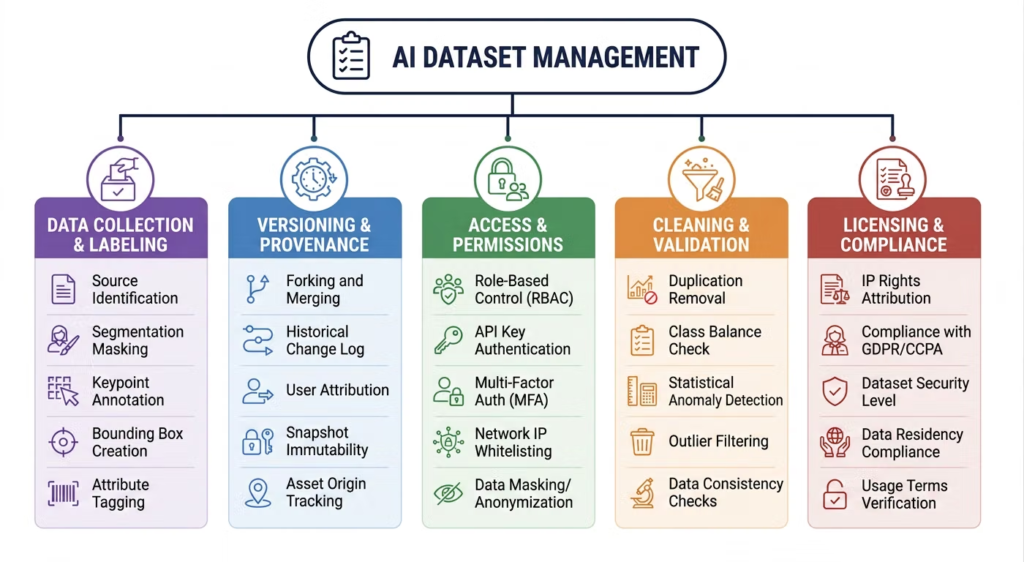
The secret: every stage feeds back into the previous one. Learning domain expertise makes you a better QA. Learning Python helps you design better workflows. Each skill compounds.
Conclusion
Data annotation in 2026 is the front door to the AI industry, but it’s a door that swings both ways. One path leads to repetitive, low-value tasks that are increasingly automated. The other path leads to a high-impact, strategic career where you are not just a “referee” but an architect of AI itself.
The distinction is simple: are you executing a label, or are you defining the strategy for data labeling? Are you just a tool, or are you teaching the tool?
By focusing on domain expertise, technical skills, and understanding the full lifecycle of data — from raw input to model deployment — you can ensure your role in the AI economy is not just sustainable but highly rewarding. The AI models of the future are being trained right now. They need people who understand nuance, context, and edge cases. They need people who can think like both a human and a machine.
You can choose to be the one drawing the boxes, or you can choose to be the one telling the AI what the boxes mean and why they matter. In 2026, that choice is entirely yours — and the time to start making it is today. Open your first annotation tool, read your first guideline document, and take that first step. The career ladder is waiting.