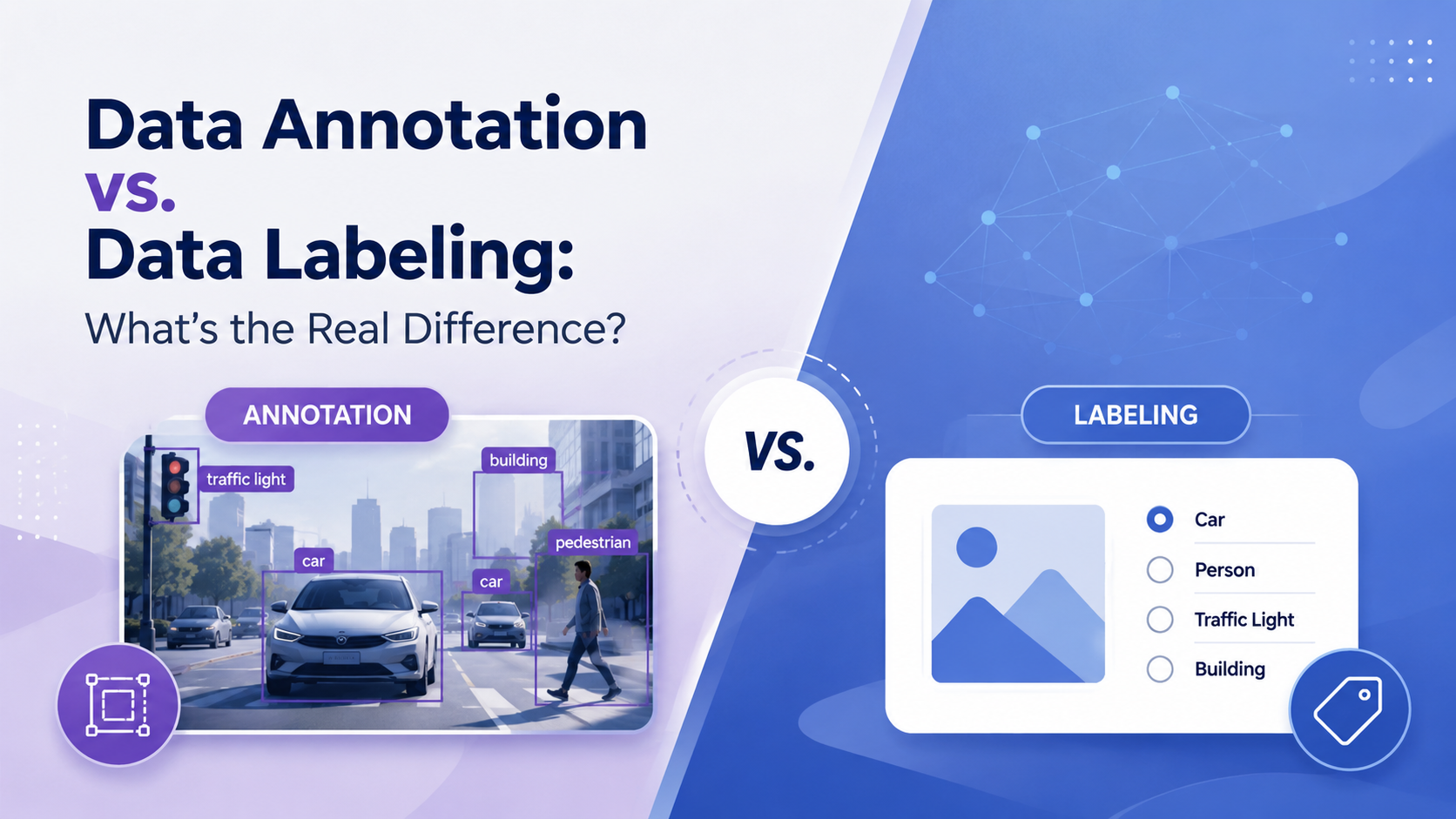
You’ve probably heard the terms data annotation and data labeling tossed around as if they’re interchangeable. But when you’re actually knee-deep in preparing a dataset for a machine learning model, treating them as synonyms can lead to serious headaches down the line. This confusion is more common than you’d think, and it’s precisely the reason many promising ML projects struggle to get off the ground—or worse, fail entirely during deployment.
While both processes are absolutely essential for supervised learning, there’s a genuine difference in scope, detail, and the type of AI you’re ultimately building.
This isn’t just about semantics or academic nitpicking; it’s about choosing the right approach to get your model to perform exactly as you expect.
In this article, we’ll cut through the confusing jargon to give you a clear, actionable understanding of data annotation and data labeling.
You’ll learn exactly when to use each approach, see real-world examples that bring the concepts to life, and walk away with practical strategies you can apply to your next project immediately.
What Exactly is Data Labeling?
Data labeling is the process of assigning a predefined category, tag, or class to an entire piece of raw data.
Think of it as giving a simple “name” or “type” to a complete data point.
It is, at its core, a form of classification where you’re answering a straightforward question about the data as a whole.
Here’s a practical example to make this concrete.
Imagine you’re building a spam filter for email.
Your labeling task would involve going through thousands of emails and assigning each one a single label:
- “spam”
- “not spam”
That’s it—a binary choice based on your judgment of the entire email’s content.
Similarly, if you’re working on an image classification project, you might label photos as containing a:
- “dog”
- “cat”
- “bird”
You’re not identifying where the animal is in the image or what it’s doing; you’re simply stating what the whole picture represents.
This process is generally straightforward and can be performed by a large number of generalist workers with basic training. This is because labeling typically involves answering simple, closed-ended questions about the data, which require minimal specialized knowledge.
The simplicity also means labeling tasks can be completed relatively quickly, making them highly scalable when you’re dealing with massive datasets.
Key characteristics of data labeling
- Simplicity: You’re assigning a single tag or category to the entire data point.
- Speed: The process is generally faster and more scalable than complex annotation work.
- Lower Cost: Because it requires less expertise, labeling is typically more affordable per data point.
- Use Case: It’s ideal for training classification models that need to distinguish between distinct, mutually exclusive categories.
A classic real-world application of labeling is in sentiment analysis.
Customer reviews are labeled as:
- “positive”
- “negative”
- “neutral”
This straightforward tagging provides the foundation for a model to predict the sentiment of new, unseen text.
Another common example is content moderation, where user-generated content is labeled as “appropriate” or “inappropriate” to train automated filtering systems.
What exactly is Data Annotation?
Data annotation, on the other hand, is a significantly more sophisticated and detailed process. It involves adding a rich layer of context, structure, and metadata to your data.
If labeling is about categorizing a whole data point, annotation is about finding and labeling the distinct parts within it, often defining their relationships and boundaries.
A perfect example is object detection in computer vision.
Instead of simply labeling an entire image as “car,” annotation would involve meticulously drawing bounding boxesaround each car in a scene, or even identifying their specific features like the license plate, wheels, and windshield.
For a project building a self-driving car, you wouldn’t just label an image as “road.” You’d need to annotate:
- lanes;
- traffic signs;
- pedestrians;
- other vehicles;
- the boundaries of sidewalks.
Each of these elements requires precise localization and identification.
The level of detail can go even deeper.
In image segmentation—a more advanced form of annotation—you don’t just draw boxes. You trace the exact outline of every pixel that belongs to an object, distinguishing it from the background at the pixel level.
This is critical for medical imaging, where you might need to outline the precise boundaries of a tumor or organ to help an AI model make diagnostic recommendations.
Annotation isn’t limited to images.
In Natural Language Processing (NLP), a task called Named Entity Recognition (NER) involves annotating text to identify and label specific entities.
For example, in the sentence:
“Apple Inc. was founded by Steve Jobs in Cupertino,”
you would annotate:
- “Apple Inc.” as an organization;
- “Steve Jobs” as a person;
- “Cupertino” as a location.
This contextual understanding is what allows AI to answer questions, summarize documents, or power intelligent chatbots.
Key characteristics of data annotation
- Complexity: It provides structured, contextual, and often spatial information about the data.
- Expertise Required: It often requires domain-specific knowledge—medical annotation needs trained professionals, legal document annotation needs legal expertise.
- Time-Intensive: The detailed nature of annotation makes it significantly more time-consuming and resource-heavy than labeling.
- Use Case: It’s essential for tasks like object detection, image segmentation, and advanced NLP that require the model to understand relationships between different data elements.
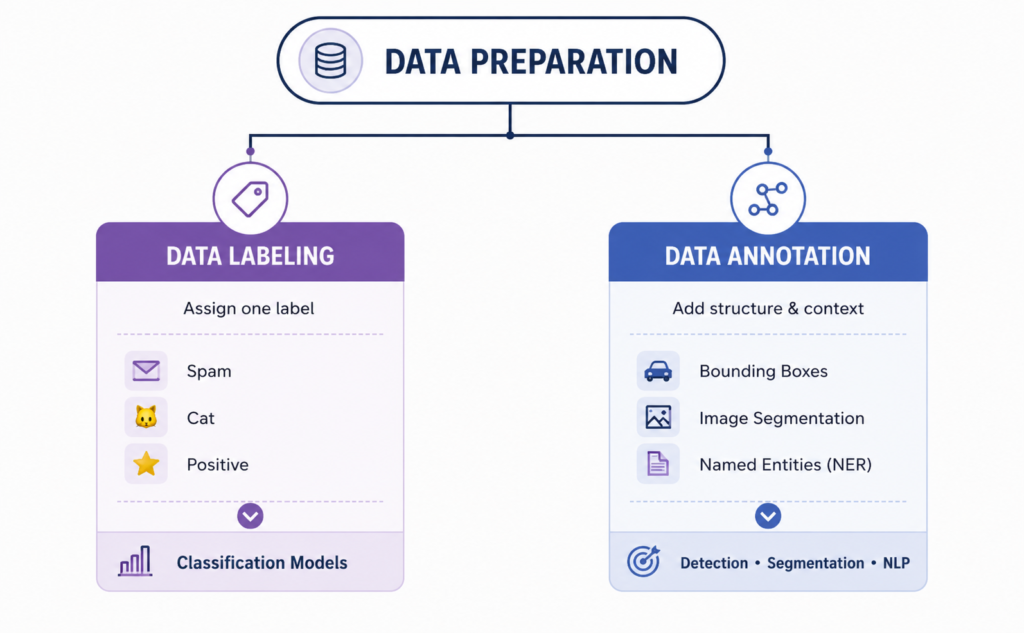
Data Labeling vs. Annotation: The TL;DR Comparison
To quickly wrap your head around the difference, consider this foundational principle:
All data labeling is a form of annotation, but not all annotation is labeling.
The key distinction lies in the level of detail and the structure of the output.
- Labeling gives you a simple answer.
- Annotation gives you a map.
Here’s a detailed comparison table to make it even clearer:
| Feature | Data Labeling | Data Annotation |
| Primary Goal | Assign a single category or class to an entire data point | Add rich context, structure, and metadata to specific parts of data |
| Complexity Level | Low; involves simple classification decisions | Moderate to High; requires detailed, often spatial or relational understanding |
| Typical Output | A single tag (e.g., “spam,” “cat,” “positive”) | Structured information (e.g., bounding boxes, pixel masks, entity lists) |
| Example | An image tagged as “Dog” | An image with bounding boxes around the dog, its breed identified, and the background segmented |
| Worker Skill Required | Generalist; minimal training required | Specialist; often requires domain expertise or extensive training |
| Time per Data Point | Seconds | Minutes to hours, depending on complexity |
| Typical Use Cases | Spam filtering, sentiment analysis, basic content moderation | Self-driving cars, medical imaging, advanced NLP, facial recognition |
Which One Do You Need? A Practical Decision-Making Guide
So, how do you decide which approach is right for your specific project?
It’s not a matter of one being inherently “better” than the other; it’s about what your specific model needs to learn to perform its task effectively.
Here’s a practical framework to guide your decision.
If you choose Data Labeling, you’re likely asking questions like:
- “Is this email spam or legitimate?”
- “Is this product review positive, negative, or neutral?”
- “Does this image contain a person, or not?”
- “Is this transaction fraudulent or valid?”
This is your go-to choice when you need a simple “yes/no” or a selection from a few distinct categories.
Your model needs to classify entire pieces of data based on their overall characteristics.
Labeling is efficient, cost-effective, and perfect for these scenarios.
If you choose Data Annotation, you’re likely asking questions like:
- “Where exactly is the car in this image, and what are its individual parts?”
- “Which specific entities (people, organizations, locations, dates) are mentioned in this legal document?”
- “How does this moving object in a video interact with its environment over time?”
- “What is the precise boundary of this organ in the medical scan?”
Choose annotation when the “where,” “how,” and “why” are just as important as the “what.”
Your model needs a deeper, more contextual understanding of the data’s structure and relationships.
This is non-negotiable for advanced AI applications that interact with the physical world or complex language.
Real-World Examples and When to Use Each
Let’s explore some concrete scenarios to illustrate the practical differences.
Example 1: E-commerce Product Categorization
Labeling Approach
You have thousands of product descriptions. You label each one with a category:
- Electronics
- Clothing
- Home Goods
This helps a model automatically categorize new products for your website.
Annotation Approach
You annotate the product descriptions to extract specific attributes. For a “laptop,” you might annotate:
- brand;
- processor type;
- RAM size;
- screen resolution.
This allows a model to create structured product data for advanced filtering and comparison.
Example 2: Autonomous Vehicle Development
Labeling Approach
You label each frame of dashcam footage as:
- Daytime
- Nighttime
or simply tag it as:
- Contains Pedestrian
- Does Not Contain Pedestrian
This is too simplistic for the actual driving task.
Annotation Approach
You annotate each frame with:
- bounding boxes around every vehicle;
- pedestrians;
- cyclists;
- lane markings;
- traffic signs;
- traffic lights.
You might even annotate the direction of movement. This rich, detailed annotation is what allows the vehicle to safely navigate complex environments.
Example 3: Medical AI Diagnosis
Labeling Approach
You label entire X-ray images as:
- Pneumonia Present
- No Pneumonia
This gives a model a rough idea but no specifics.
Annotation Approach
You annotate the X-ray by having a radiologist draw precise boundaries around any areas of opacity or consolidation in the lungs. This pixel-level detail allows the model to not only detect pneumonia but also assess its:
- severity;
- location;
- spread.
The Hidden Costs and Considerations
When planning your data strategy, it’s crucial to look beyond just the immediate cost per data point.
Data annotation might be more expensive upfront, but it can save you significant time and resources in model development and refinement. A model trained on rich, annotated data is often:
- more robust;
- requires fewer iterations;
- generalizes better to new, unseen data.
Conversely, while labeling is cheaper and faster, it often leads to models that are less capable of handling nuanced or edge cases. If your business relies on detecting subtle fraud patterns or understanding complex customer sentiment, simple labeling might not provide enough signal for the model to learn effectively.
There’s also the issue of “label noise”—when labelers make mistakes due to ambiguity or lack of context. A 2022 study by researchers from MIT and Amazon found that label errors are surprisingly common across popular benchmark datasets, with significant implications for model evaluation and performance.
Furthermore, consider the long-term maintainability of your data. If you start with simple labeling and later realize you need more detailed information, you may have to go back and re-annotate your entire dataset from scratch. This “do-over”can be incredibly costly and time-consuming. It’s often more efficient to invest in richer annotation from the start if you anticipate your project’s needs will evolve.
Frequently Asked Questions
Q: Is data labeling just a simpler version of data annotation?
Not exactly. While labeling is simpler in terms of the output required, it’s better to think of them as serving different purposes rather than one being a “lite” version of the other. Labeling is about classification of entire data points. Annotation is about providing structural detail within data points. You wouldn’t say a hammer is a simpler version of a screwdriver—they’re different tools for different jobs.
Q: Can I use the same team or platform for both labeling and annotation?
Yes, many data labeling platforms support both tasks, but the teams involved might differ. Labeling can often be handled by a large pool of generalist workers with minimal training. Annotation, especially for specialized domains like medical imaging or legal documents, typically requires workers with subject-matter expertise. You can use the same platform but will likely need different worker pools and quality control processes.
Q: Which one is more expensive?
Annotation is almost always more expensive per data point. The reasons are straightforward: it takes more time, requires more skilled workers, and often involves more complex quality assurance processes. However, labeling can become expensive too if you’re dealing with massive datasets. A million labeled images might cost more in total than a thousand annotated medical scans.
Q: Can I start with labeling and later add annotation?
Technically yes, but practically it’s often problematic. If you start with simple labels and later decide you need detailed annotations, you’ll have to go back and re-process all your data from scratch. This is both expensive and time-consuming. If you anticipate needing detailed information in the future, it’s usually more cost-effective to invest in annotation from the beginning rather than paying twice.
Q: Do I always need to choose between labeling and annotation?
Not necessarily. Many projects use a hybrid approach. For example, you might first label images to filter out irrelevant ones (e.g., discarding images without any cars), and then annotate the remaining images in detail. The key is to think strategically about where to invest your data preparation budget for maximum impact on model performance.